The buffer overflow is forty years old and still shipping in production C. Understanding why it persists — and why each defense only raised the bar instead of closing the door — is the difference between patching symptoms and writing safe code.
The classic bug
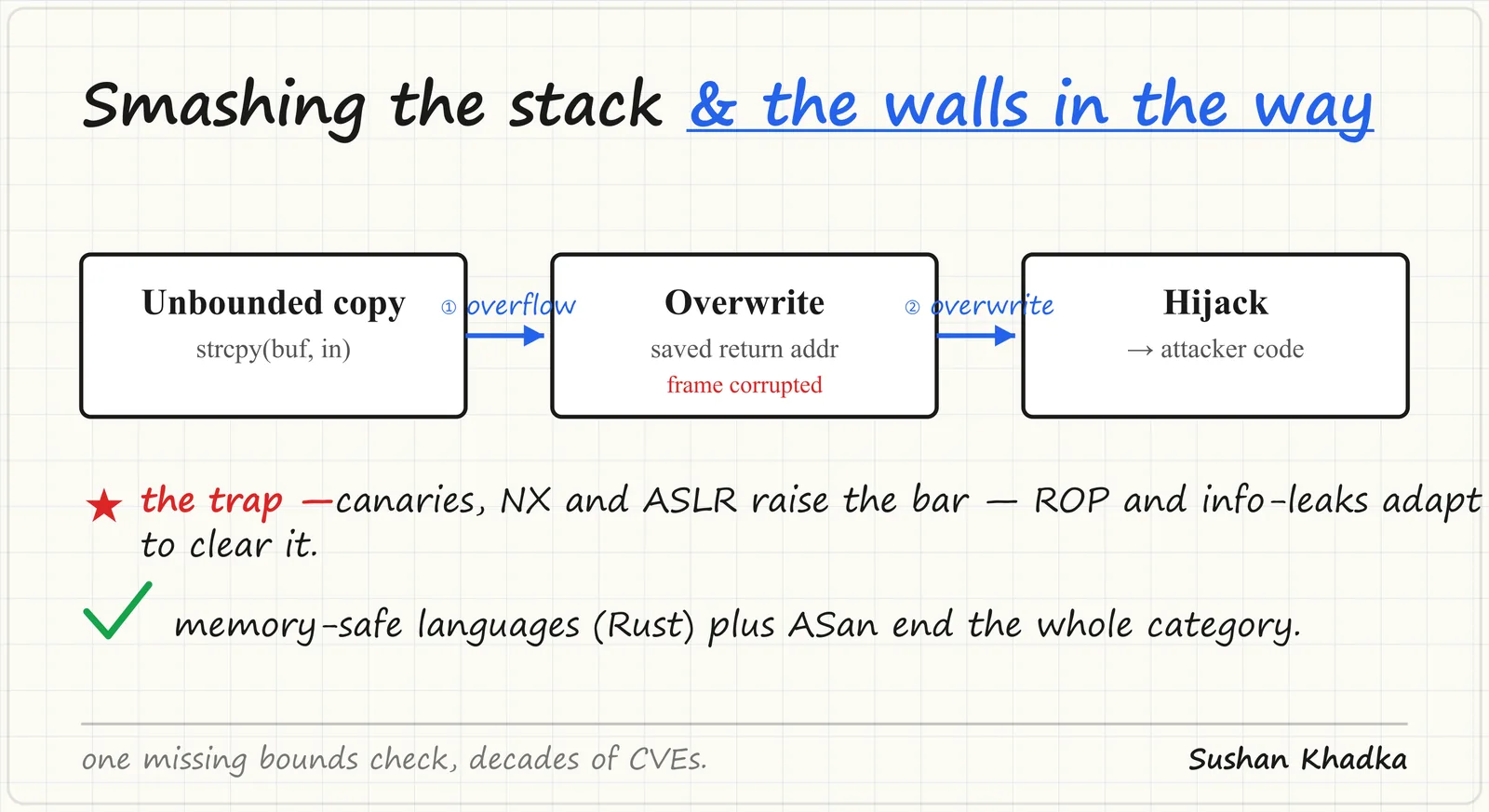
A function reserves a fixed buffer on the stack. Right above it sits the saved return address — the pointer the CPU jumps to when the function ends. When code copies input without checking its length, an oversized write spills past the buffer and overwrites that return address. Now the attacker controls where execution goes next. No magic, just an unbounded copy writing into memory that was never meant to hold user data.
void greet(char *name) {
    char buf[64];
    strcpy(buf, name);   // no bounds check — 65+ bytes overflow buf
    printf("Hello, %s\n", buf);
}
strcpy copies until it hits a null byte, with no idea how big buf is. Hand it 64 bytes of filler plus a new 8-byte address and the return pointer becomes whatever you chose. The function returns — straight into attacker-controlled territory. This is stack smashing, and strcpy, gets, sprintf, and unchecked memcpy have all been the delivery vehicle.
Why C lets this happen
The root cause is a language design decision, not a mistake in any one program. C arrays are just pointers with no length attached; the language performs no bounds checking because that check would cost cycles, and C's founding bargain was maximum performance and control. That bargain was right for 1972 and is a liability in 2025 — it means the programmer is solely responsible for never writing past the end of a buffer, across millions of lines, forever. Humans are not good at "never," which is why the bug class refuses to die.
The mitigation ladder
Each defense answered the previous attack, and each was answered in turn. It is genuinely a decades-long arms race:
- Stack canaries: a secret random value placed just before the saved return address. Before the function returns, the runtime checks the canary is intact; a linear overflow that reaches the return address must first overwrite the canary, so the check fails and the program aborts. Defeated by leaking the canary value, or by overwrites that skip over it.
- NX / DEP: marks the stack non-executable, so injected shellcode sitting in a buffer simply won't run as code. Defeated by not injecting code at all (see ROP).
- ASLR: randomizes the memory layout — stack, heap, libraries — on each run, so the attacker can't hard-code where anything lives. Defeated by an information leak that reveals one real address.
- CFI (Control-Flow Integrity): checks at runtime that indirect jumps and returns land only on legitimate, expected targets, cutting off the arbitrary control transfers exploits depend on.
How attackers adapt
NX killed code injection, so attackers stopped injecting code. Return-oriented programming (ROP) stitches together short snippets of existing executable code — "gadgets," each ending in a ret — that already live in the binary and its libraries. By overwriting the stack with a sequence of gadget addresses, the attacker builds an arbitrary payload out of the program's own instructions, never introducing a single new byte of code. NX sees only legitimate, executable, already-present instructions and waves it through.
That leaves ASLR as the real obstacle, because ROP needs to know the addresses of its gadgets. This is why modern exploitation is really a hunt for an information leak — a format-string bug, an uninitialized read, an out-of-bounds read — that reveals one real runtime address. From that single leak the attacker recomputes the whole library's layout (everything shifts by the same offset) and the ROP chain snaps back into place. The lesson worth internalizing: defenses compose, but one leak can unravel several at once. A read primitive is not "low severity" when it re-enables a write primitive.
The real fix
Mitigations are speed bumps; they assume the bug exists and try to limit the damage. Useful, but every one of them has a documented bypass, because they treat the symptom. The durable answer is to not have the bug — to make the entire class impossible rather than survivable.
- Write memory-safe languages. Rust enforces bounds and ownership at compile time, so buffer overflows are gone by construction, not by luck. Go, Java, and others check bounds at runtime. For new systems code, this is the highest-leverage decision you can make.
- Harden the C and C++ you can't rewrite. Run AddressSanitizer in CI to catch out-of-bounds access during testing, and throw fuzzing at every parser and input path — that's how you find the unbounded copy before an attacker does. Replace the dangerous functions (
strcpy→strlcpy,gets→fgets). - Turn on the compiler's defenses by default:
gcc -fstack-protector-strong -D_FORTIFY_SOURCE=2 -pie -fPIE app.c-fstack-protector-strong inserts canaries, _FORTIFY_SOURCE=2 swaps risky libc calls for bounds-checked variants where the size is known, and -pie -fPIE makes the main executable itself position-independent so ASLR can randomize it too.
None of this makes C safe. It makes it less unsafe — and buys time until the code can move to a language where the whole category simply doesn't exist.
The takeaway
- The root cause is one unchecked copy overwriting the saved return address — and C's no-bounds-checking bargain is why it keeps happening.
- Mitigations stack but don't close the hole — ROP plus an info-leak walks past canaries, NX, and ASLR.
- A read bug can be as dangerous as a write bug — one leaked address defeats ASLR and re-arms the whole chain.
- Eliminate the bug class: Rust by default for new code, ASan and fuzzing plus hardening flags for the C you can't rewrite.